

When To Use Root Test
In this lesson, we will learn nigh the ratio test. This test requires you to calculate the value of R using the formula below. If R is greater than 1, then the serial is divergent. If R is less than 1, and so the series is convergent. If R is equal to 1, then the test fails and y'all would have to use another examination to show the convergence or deviation of the series. It is really recommended to use this test if your series has factorials in it. We will exercise a few questions which involve using the ratio examination, and so look at a question that requires usa to employ the ratio test twice.
Ratio Test
Convergence tests are used to detect the convergence of series or power serial. In that location are many tests for convergence, but in this article nosotros are going to focus on the ratio test. Ratio exam is one of the tests used to determine the convergence or divergence of infinite series. You can even use the ratio test to discover the radius and interval of convergence of ability series! Many students have bug of which test to use when trying to notice whether the serial converges or diverges. We recommend y'all to use this series test if your series appear to have factorials or powers.
The definition of the ratio exam is the following:
Let there exist a series . Then we say that:
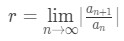
Where:
If r < 1, then the series is convergent. A converging series means that the infinite series has a finite sum.
If r > 1 (including infinity), and so the series is divergent. This means the infinite serial sums up to infinity.
If r = 1, and then the serial could either be divergent or convergent.
Basically if r = one, and so the ratio test fails and would crave a different test to determine the convergence or divergence of the series. I am non going to provide a proof as to why the ratio test works, merely this link here provides a step by step formal proof of information technology.
http://blogs.ubc.ca/infiniteseriesmodule/appendices/proof-of-the-ratio-examination/proof-of-the-ratio-test/
Why don't we take a look at some ratio test examples and learn how to fully utilize the ratio test.
Ratio test for convergence
Allow's have a look at the post-obit series:
-

Equation 1: Convergence Ratio test pt. 1 -
Permit'due south see whether the series converges or diverges. Right away, y'all run into a factorial in the series. This means that ratio test is recommended. Let

Equation 1: Convergence Ratio test pt. 2 -
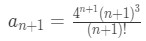
And so then we will as well have
Equation 1: Convergence Ratio exam pt. iii -
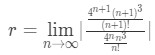
Using these two and plugging them into the ratio test formula will requite us:
Equation 1: Convergence Ratio test pt. 4 -
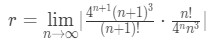
We know that when y'all are dividing a fraction, and so that is the same as multiplying the reciprocal of the fraction. Thus, we can change this to
Equation 1: Convergence Ratio test pt. 5 -
What I like to do is match all the numerators and denominators I see here. Notice that I tin match the powers, factorials and polynomials so that it looks like this:

Equation 1: Convergence Ratio exam pt. 6 -
Find that the powers from the 4's can abolish. Hence this volition give u.s.a.:

Equation i: Convergence Ratio test pt. seven -
Too, the cube of the polynomials tin can be factored. Doing and then leads to

Equation 1: Convergence Ratio test pt. 8 -
In addition, we tin apply the factorial rules to aggrandize out the factorials. Doing all of this volition requite us:

Equation i: Convergence Ratio test pt. 9 -
Detect that expanding the factorials leads all the terms to cancel except or northward+ane in the denominator. Hence, nosotros can conclude that simplifying factorials leads to:

Equation 1: Convergence Ratio exam pt. 10 -
Within the brackets, we are going to divide the n+ane by n, and then nosotros will end upward with

Equation one: Convergence Ratio test pt. 11 -
Now we are really going to take the limit hither. Notice that as → , goes to 0. In addition, The inside the brackets will become 1. Withal, it will be multiplied by 0, so the entire limit will go to 0. Therefore

Equation ane: Convergence Ratio examination pt. 12
We know that 0 < 1, so what does the ratio test conclude? It concludes that the series converge. Note that using the ratio examination does not tell yous the sum of the series; you lot would accept to use another means to practice that.Now allow'southward take a look at a case in which the ratio examination says the series diverges.
Ratio test for divergence
Let's exam for divergence in the following series:
-
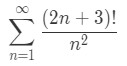
Equation 2: Divergence Ratio test pt. one -
Once more we meet the factorial, then it volition be wise to use the ratio test.
Allow
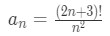
Equation 2: Divergence Ratio test pt. 2 -
So we will have that:
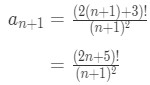
Equation 2: Divergence Ratio exam pt. 3 -
Hence using the ratio test formula will give u.s.:
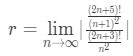
Equation 2: Deviation Ratio exam pt. iv -
Again nosotros can just this so that we don't have a fraction on acme of a fraction. Instead we tin modify this to multiplying by the reciprocal of the fraction. This gives us:
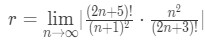
Equation 2: Divergence Ratio examination pt. 5 -
Permit's match the polynomials and the factorials then that we have
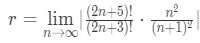
Equation 2: Divergence Ratio test pt. vi -
We can expand out the factorials so that

Equation two: Difference Ratio test pt. 7 -
Notice that the terms can cancel so that we tin just the equation to:

Equation ii: Divergence Ratio exam pt. viii -
Multiplying the fractions together and expanding the denominator volition give u.s.a.:
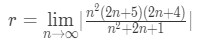
Equation two: Departure Ratio exam pt. 9 -
Factoring out of the denominator leads to:
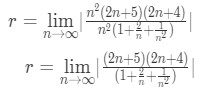
Equation 2: Departure Ratio examination pt. x -
Now we should be able to take the limit as → . Find that taking the limit leads to the denominator condign 1, and the numerator goes to infinity. Hence the unabridged limit goes to infinity. Hence we tin can conclude that:

Equation 2: Divergence Ratio test pt. 11 -
Since > one, so we tin can conclude that the series goes to infinity.
If you desire to look at more examples of ratio tests with converging or diverging series, click the lesson tab. While we are talking about ratio test, we might likewise talk about the root test as well. Why? Because they are very similar!
Root test
Allow at that place be a series . Then we say that:
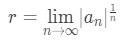
Where:
If r < 1, so the serial is convergent
If r > 1 (including infinity), then the series is divergent
If r = 1, then the serial could either be divergent or convergent.
Basically if r=1, then the root exam fails and would require a different test to determine the convergence or difference of the series. Realize that these rules are exactly the same as the ratio examination! Again, I am not going to provide a proof that the root test works, simply I will post a link hither showing the proof:
http://people.sju.edu/~pklingsb/pfroot.pdf
Let's look at an instance of using the root test!
Consider the following serial:
-

Equation iii: Divergence Root test pt. one -
Start we ready:

Equation three: Departure Root test pt. 2 -
Now using the root test, we will accept that:
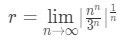
Equation 3: Deviation Root exam pt. three -
Observe that we can gene the ability of northward in both the denominator and numerator and so that:
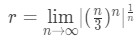
Equation 3: Divergence Root test pt. four -
We can fifty-fifty factor the power of n out of the absolute value so that:
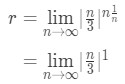
Equation 3: Divergence Root test pt. five -
Now taking the limit of this as → will issue in r beingness infinity. In other words,
Equation iii: Divergence Root exam pt. 6 -
Since r = >1, so we know that the series is divergent.
Since we very familiar with the ratio test and root exam now, allow us talk well-nigh finding the interval of convergence.
How to detect interval of convergence
Nosotros are able to find the interval of convergence of a power series. Power serial are in the course
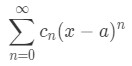
Where are the coefficients of each term in the serial and a is a number the series is centred around. We are able to find the radius and interval of convergence if nosotros accept either the ratio examination or the root exam. Depending on the power serial, one test may be more convenient than the other. How do we find the interval of convergence using the ratio exam?
Let
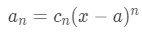
And then applying the ratio test volition requite:

Afterward taking the limit, set up r < 1 and and then manipulate the inequality so that it takes the form of |x-a| < R, where R is the radius of convergence.
The interval of convergence is the value of all x's, for which the ability series converges. This interval will be

Information technology is likewise important to bank check the endpoints of this inequality (-R+a and R+a) to come across if they converge as well. If information technology is, then include them into the inequality!
Note that in that location are some cases in which nosotros cannot get the inequality |x-a| < R. Yous might merely finish upwards getting r = 0 < i. This ways that for all x values, r = 0. Hence, the radius of convergence is and the interval of convergence is - < x < . Y'all likewise might get a instance where r = . In that case, the power series is always divergent for all 10.
Alright, at present that nosotros know what the radius and interval of converge is, why don't nosotros exercise a few examples?
Let's take a look at the power series:
-

Equation iv: Ratio test Interval of Convergence pt. 1 -
Since we see factorials, it will be more convenient to employ the ratio examination here. Permit

Equation 4: Ratio test Interval of Convergence pt. 2 -
Then,
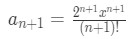
Equation iv: Ratio exam Interval of Convergence pt. iii -
Applying the ratio test formula gives us:
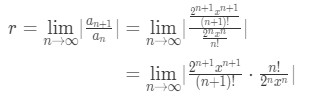
Equation 4: Ratio test Interval of Convergence pt. 4 -
Matching the powers and the factorials will give u.s.:

Equation iv: Ratio examination Interval of Convergence pt. 5 -
See here that we can abolish some of the powers and then that:
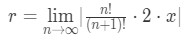
Equation 4: Ratio test Interval of Convergence pt. 6 -
Expanding the factorials out will lead to lots of terms cancelling:
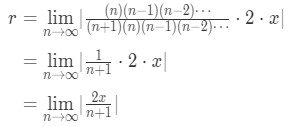
Equation four: Ratio examination Interval of Convergence pt. 7 -
We can factor x out of the absolute value so that:
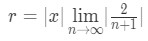
Equation 4: Ratio test Interval of Convergence pt. 8 -
Find that we have to put an absolute value effectually the ten when factoring information technology out of the absolute value. Now taking the limit will give us:

Equation four: Ratio test Interval of Convergence pt. 9
You may see that this is not in the grade |x-a| < R. However discover that r = 0 < 1 for all 10 values. This means that for all x values, the power serial converges. Hence the radius of convergence is infinity, and the interval of convergence is - < x < (because it converges everywhere).
How do nosotros detect the interval of convergence using the root exam? Well once more, we simply use the root test formula and set r<1and try to get the inequality |x-a|
Find again that you volition encounter cases where you will end up either getting r = 0 < 1 or r = . r = 0 implies the power series is convergent for all x values, and r = implies the power series is divergent always.
Now let us take a look at a instance where we find the interval of convergence using the root examination. Consider the power serial:
-
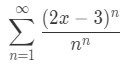
Equation 5: Root examination Interval of Convergence pt. one -
We desire to apply root exam here because nosotros see a lot of powers of n. So let
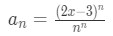
Equation five: Root exam Interval of Convergence pt. 2 -
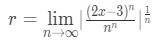
Recollect that the root exam formula is
Equation 5: Root exam Interval of Convergence pt. three - Hence nosotros will become:
Equation v: Root exam Interval of Convergence pt. 4 -
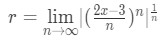
Factoring the powers of n out in the accented value gives:
Equation 5: Root examination Interval of Convergence pt. v -
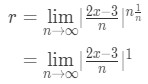
Observe that nosotros tin can factor the power of n outside of the absolute value so that
Equation 5: Root exam Interval of Convergence pt. half dozen -
We can factor 2x-iii out of the absolute value so that:
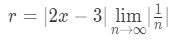
Equation v: Root test Interval of Convergence pt. 7 -
Taking the limit volition yield the outcome:
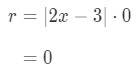
Equation five: Root test Interval of Convergence pt. 8 Again nosotros have the case that r = 0 < 1, hence we can conclude that the power series converge for all 10 values. In other words, the radius of convergence is , and the interval of convergence is - < 10 < .

When To Use Root Test,
Source: https://www.studypug.com/calculus-help/ratio-test
Posted by: loefflergivy1941.blogspot.com
0 Response to "When To Use Root Test"
Post a Comment